
It depends on which features you value most. If your top priority is having the authentic touch, response, and sound of an acoustic piano, with the added benefits or modern technology, then a hybrid piano such as the Yamaha U3 SH3 SILENT is worth exploring. If you prefer a low-maintenance option and don’t want to worry about annual tunings, a Yamaha AvantGrand or digital piano may be a better fit.

Starting your search for a new piano is an exciting journey that may seem overwhelming at first. Many of our customers begin their search by comparing digital vs acoustic piano options, but did you know there’s another option worth considering called a hybrid piano? In this guide, we’ll walk through the key differences of each category so that you can confidently choose the piano that’s right for your goals, space, and budget.
What Is an Acoustic Piano?
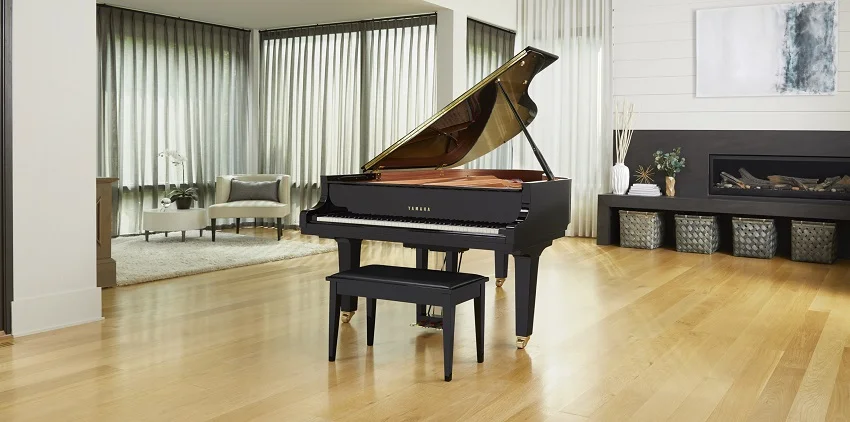
An acoustic piano has nearly 12,000 parts and uses the hammers, strings, and soundboard to produce sound. Acoustic pianos are available as either upright or grand pianos. Upright pianos such as the Yamaha U1 assemble the soundboard and strings vertically which allow for a smaller footprint and makes them an ideal choice when space is limited. They typically range between 42” to 52” in height and require approximately 5’ x 2’ of space. Grand pianos such as the Yamaha C3X assemble the soundboard and strings horizontally. The action features double escapement and is gravity assisted which allows for faster repetition. Grand pianos are about 5’ wide and are typically available in lengths between 5’ to 9’.
How an Acoustic Piano Makes Sound
When you press a key down on an acoustic piano, a complex mechanism called the action forces a felt-covered hammer to strike one, two, or three strings. The vibration of the strings is then transferred through the bridge onto the soundboard which naturally amplifies the sound. This mechanical process gives acoustic pianos their unmatched expressiveness. The sympathetic resonance that’s created while playing can add depth while also making the sound feel rich and nuanced.
Key Features & Considerations of Acoustic Pianos
Acoustic pianos remain the standard for most players and are often recommended by teachers so that students can develop proper technique.
Key features:
- Longer key stick length compared to most digitals allow for more control.
- Naturally graded weight that feels heavier in the bass section and lighter in the treble section provides an authentic touch and response.
- Wide dynamic range with room-filling resonance.
- Long-term resale value especially from reputable brands and models.
Considerations:
- Needs regular tunings 1-2 x per year, but may vary depending on how often you play.
- Sensitive to changes in humidity and climate.
- Requires more floor space than a digital piano.
What Is a Digital Piano?
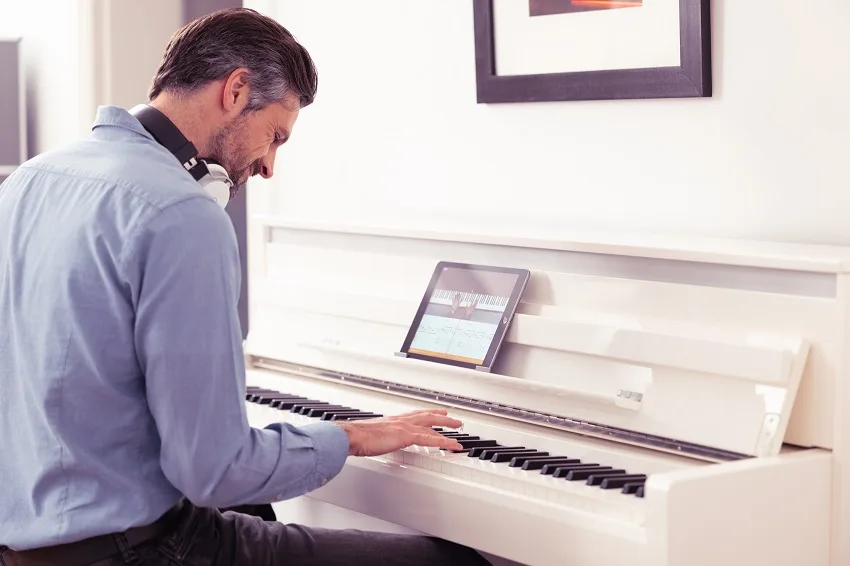
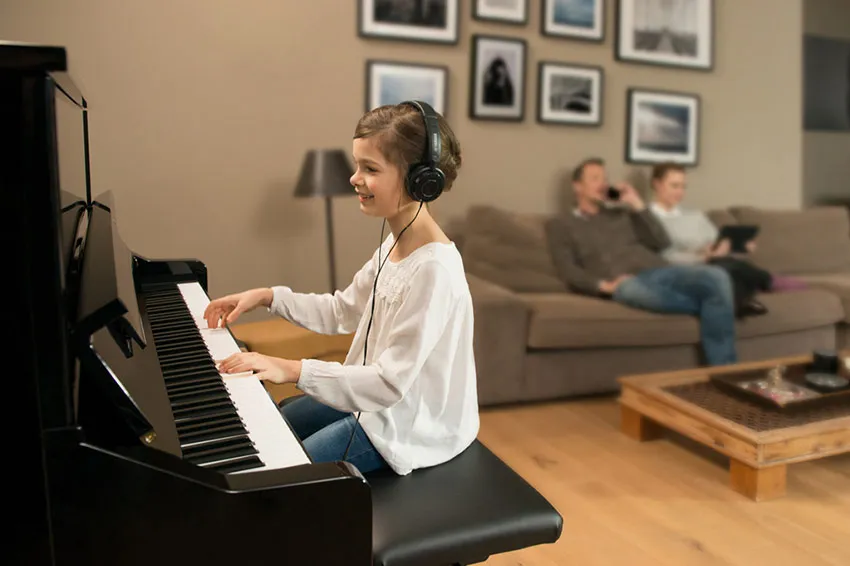
The primary difference between digital and acoustic pianos comes down to how sound is produced. A digital piano creates sound electronically using recordings of other instruments and generally requires less space than acoustic pianos. The smaller footprint combined with the ability to practice with headphones makes them ideal for apartments, condos, and shared living spaces. For example, the console style Yamaha CLP-825 measures at only 53” w x 16” d, while the grand style Yamaha CVP-909GP is 56” w x 49” d offering the elegance of a grand piano in a more space-conscious design.
How a Digital Piano Works
In lieu of strings, a digital piano holds high-quality recordings, or samples, of every note captured from a real acoustic piano. When you press a key down, a sensor captures the note and movement, which is then played back through built-in speakers or headphones.
Premium models such as the Yamaha Clavinova, deliver an authentic piano-playing experience with weighted, graded keys, adjustable touch sensitivity, and advanced sound modeling that recreates the interaction of string and soundboard resonance. Some of their higher-end models include real wooden keys, counterweights, and longer key support length for an ultra-realistic feel.
Key Features & Considerations of Digital Pianos
Digital pianos are designed to offer convenience and flexibility while recreating an authentic playing experience.
Key features:
- Does not require tunings.
- Compact and space-saving, ideal for apartments and shared rooms.
- Volume control and headphone jacks for silent practice at any hour.
- Loaded with features like recording, interactive lessons, and a range of instrument sounds, with feature-rich models like the Yamaha Clavinova CVP-909 adding hundreds of instrument sounds and accompaniment styles.
- Lighter and easier to move than acoustic pianos.
- USB and Bluetooth connectivity.
Considerations:
- May feel less organic or natural to play, although touch, response, and sound quality can vary significantly depending on the manufacturer and model
“Weighted keys” does not mean realistic piano feel. - Resale value generally depreciates faster than acoustic pianos.
- Lower end portables that are not equipped with 88 keys or have a spring action, may not be sufficient for developing proper technique and strength.
What Is a Hybrid Piano?
A hybrid piano combines the best of both acoustic and digital pianos, blending traditional craftsmanship with modern technology. Yamaha offers four types of hybrid pianos: the AvantGrand, SILENT Piano, TransAcoustic, and Disklavier, each designed to meet the everchanging needs of today’s musicians. Yamaha hybrid pianos provide innovative solutions without having to compromise on the features or performance you value most.
What are the Different Types of Hybrid Pianos?
Yamaha AvantGrand
The Yamaha AvantGrand combines the realistic experience of playing an acoustic piano with the convenience of digital technology. If you’re trying to decide between an acoustic vs digital piano, this series is certainly worth considering.
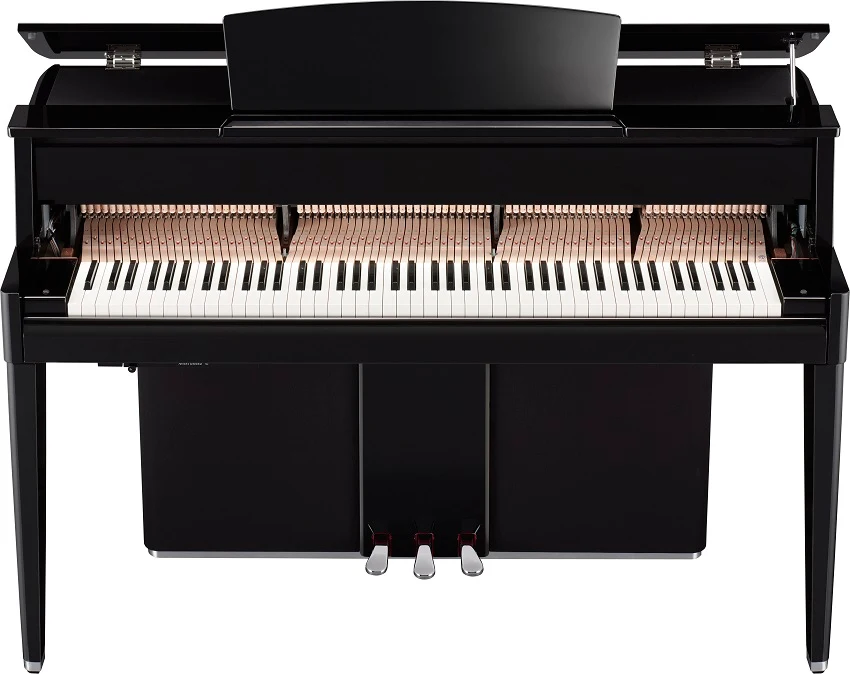
There are four different AvantGrand models, one of the standout features that differentiates these from a digital piano is that they are equipped with a genuine acoustic piano action. The Yamaha AvantGrand NU1XA features an upright action while the other three models feature a grand piano action. Samples are taken from world-class concert grands and some models such as the Yamaha AvantGrand N3X include a Tactile Response System that reproduces the vibrations felt on an acoustic piano, along with a multi-channel speaker system and soundboard resonator for a remarkably realistic playing experience. Those who want the flexibility of a digital piano can enjoy a variety of instrument voices, built-in recording, connectivity options, volume control and the ability to practice silently with headphones.
Yamaha SILENT Piano
For those who absolutely must have an acoustic piano and are trying to decide if a hybrid piano vs acoustic piano is right for them, there are several options to consider. First up, is the Yamaha SILENT Piano, which is a real acoustic piano with a factory-installed silent system that allows you to play your piano acoustically or silently with headphones, giving you the flexibility to practice any time of day or night without disruptions.
Most of the current Yamaha and Bösendorfer upright and grand pianos are available as SILENT Pianos including the popular Yamaha U1 SH3 SILENT. Once silent mode is engaged, the silent mechanism prevents the hammers from striking the strings. A sensor captures the keystrokes being played, the digital sample is then played through your headphones, all without affecting the touch of the piano.
In addition to quiet practice, the SILENT Piano includes a wide selection of instruments to choose from, Bluetooth/AUX/MIDI connectivity options, the ability to stream audio to your piano, along with built-in and USB recording. You can also connect external speakers if you prefer to play out loud.
Yamaha TransAcoustic
The Yamaha TransAcoustic piano expands the capabilities of a SILENT Piano, giving you even more flexibility. The TransAcoustic system comes factory installed and allows you to play your piano acoustically, silently with headphones, or use the soundboard to naturally amplify digital sounds and control the volume as you play out loud.
The selection of Yamaha TransAcoustic models is slightly more limited than the SILENT Piano line-up, but are still available in both upright and grand models. The TransAcoustic system works similarly to the SILENT Piano, but includes a transducer that transmits digital sounds to the soundboard giving you the ability to transform your acoustic piano to anything from a harpsichord to a 9’ concert grand. The system also includes Bluetooth/AUX/MIDI connectivity options, audio streaming, and built-in and USB recording capabilities.
Yamaha Disklavier
The Yamaha Disklavier is the world’s most advanced reproducing player piano, combining the beauty and performance of a true acoustic piano with cutting-edge technology. The Disklavier player system comes factory installed on select Yamaha and Bösendorfer upright and grand pianos and can be enjoyed by players of all skill levels and those who simply love listening to live music.
The Disklavier player piano is truly the all-in-one entertainment system, allowing you to stream music from your favorite artists or enjoy concerts on your TV while it plays in-sync with your piano. With the ENSPIRE app, you can easily control your piano from your smart device, choose from a wide selection of digital instruments, or create custom playlists for you to enjoy at any time. ENSPIRE ST & PRO models allow you to record, save, and playback your own performances or practice silently with headphones.
Key Features & Considerations of Hybrid Pianos
Hybrid pianos combine traditional craftsmanship with the convenience of digital technology, giving you flexibility and authenticity without compromise.
Yamaha AvantGrand
Key features:
- Real acoustic piano action for authentic touch and response
- Piano sound sampled from world-class Yamaha and Bösendorfer concert grands
- Does not require tunings
- Ability to control volume while playing out loud or practice silently with headphones
- Includes features such as built-in recording, an array of digital voices, and connectivity options
Considerations:
- The NU1XA and N1X require the same floor space as an acoustic upright
Yamaha SILENT Piano

Key features:
- Real acoustic Yamaha upright or grand piano
- Practice quietly with headphones
- Sensors do not impact the feel of the piano
- Piano sounds are sampled from the Yamaha CFX & Bösendorfer Imperial
- Includes an array of digital voices, rhythms, recording capabilities, Bluetooth/AUX/MIDI connectivity options
Considerations:
- Requires tunings 1-2 x per year
- Digital sound is played through headphones, external speakers are required to play out loud
Yamaha TransAcoustic
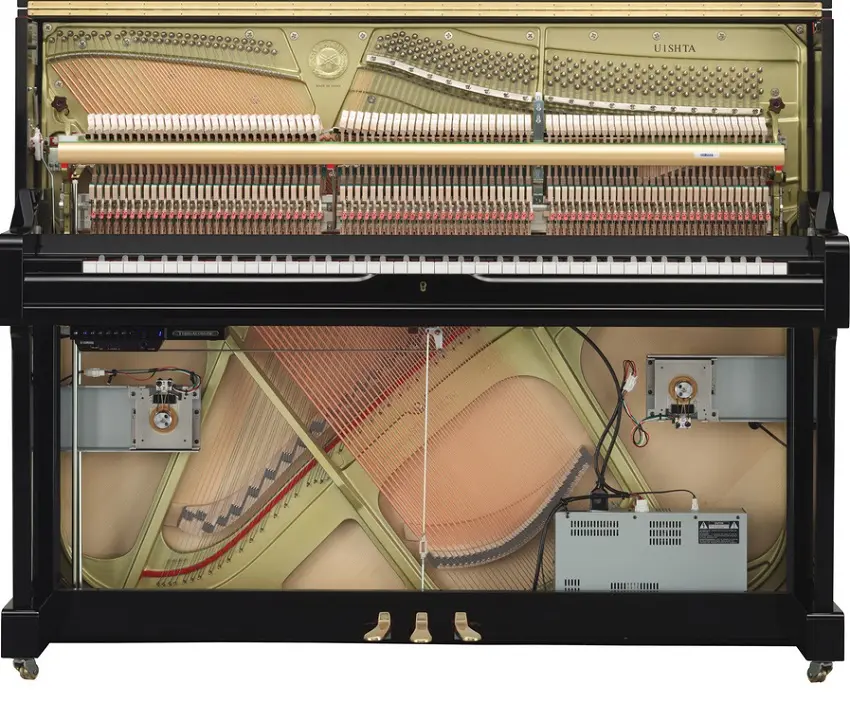
Key features:
- Same key features as the Yamaha SILENT Piano
- Digital sounds can be played through the headphones or out loud using the soundboard as a speaker
- Control the volume as you play out loud in TransAcoustic mode
Considerations:
- Requires tunings 1-2 x per year
Yamaha Disklavier
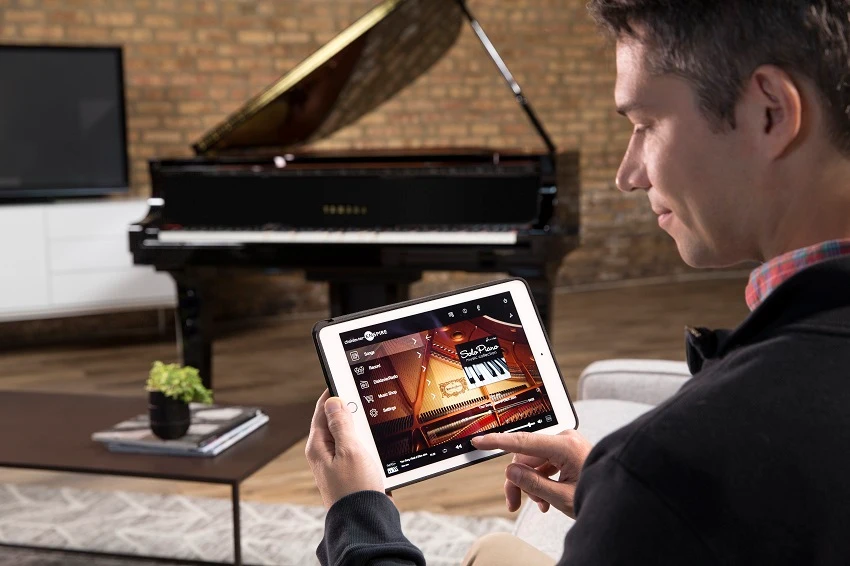
Key features:
- Real acoustic Yamaha upright or grand piano with fully-integrated player system
- Enjoy piano music and background accompaniment from your favorite artists with streaming radio service and a huge selection of pre-loaded songs
- Record, save, and playback your own performances*
- Ability to practice quietly with headphones*
- Intuitive app that allows you to control your piano from your smart device
- Sensors do not impact the feel of the piano
- Selection of digital voices*, ensemble voices, and drum kits
*Excludes ENSPIRE CL
Considerations:
- Requires tunings 1-2 x per year
- Electronics require periodic updates
- Piano Radio & DisklavierTV require a yearly paid subscription
Acoustic vs. Digital vs. Hybrid: Side-by-Side Comparison
Before you commit, it helps to see a comparison of which features buyers care about most. Here, we’ll be comparing new and current models in Yamaha’s line-up.
| Feature | Digital | Acoustic | AvantGrand Hybrid | SILENT Piano Hybrid | TransAcoustic Hybrid | Disklavier Hybrid |
|---|---|---|---|---|---|---|
| Sound Source | Samples | Strings & Soundboard | Samples | Strings & Soundboard; Samples | Strings & Soundboard; Samples | Strings & Soundboard; Samples |
| Touch & Feel | Designed to mimic the feel of a real action | Real acoustic action | Real acoustic action | Real acoustic action | Real acoustic action | Real acoustic action |
| Maintenance | Does not require tuning | Tuning and maintenance as needed | Does not require tuning | Tuning and maintenance as needed | Tuning and maintenance as needed | Tuning and maintenance as needed |
| Headphone Capability | Yes | No | Yes | Yes | Yes | Yes, on select models |
| Space | Requires the least amount of space Ex. Yamaha YDP-105: 53” x 17” |
Uprights are approx. 5’ x 2’ Grands are approx. 5’ x 5’ to 9’+ |
Larger than digital smaller than acoustic depending on model. Ex. Yamaha NU1XA: 59” x 18” and N3X: 58” x 47” |
Requires same amount of space as acoustic pianos | Requires same amount of space as acoustic pianos | Requires same amount of space as acoustic pianos |
| Prices | New models start at $1,399 | New uprights MSRP start at $5,699 New grands MSRP start at $16,699 |
New models start at $7,900 | New uprights MSRP start at $10,649 New grands MSRP start at $21,649 |
New uprights MSRP start at $12,249 New grands MSRP start at $37,349 |
New uprights MSRP start at $31,449 New grands MSRP start at $26,999 |
How to Choose the Right Piano for You
The best piano is the one that fits your lifestyle and goals. Here are a few helpful items to consider before getting started.
Consider Your Lifestyle
If you live in an apartment or condo, have roommates, or live in a busy household and need disruption-free practice, you’ll want to look at pianos that allow you to play quietly with headphones. With Yamaha’s extensive line-up of hybrid pianos, silent practice isn’t limited to only digitals. If you’re someone who is very limited on space or you move frequently and need the ability to move a piano on your own, the smaller dimensions and lighter weight may make a digital piano more suitable for you.
Consider Your Space
Choosing the right size piano is important. Before meeting with one of our piano advisors, measure the room where your piano will be placed to ensure it fits comfortably. The piano should be large enough to produce a full and balanced sound without overwhelming the space. Our piano advisors can help with the proper placement of the piano ensuring it looks and sounds beautiful when it arrives to your home. You can also request a grand piano template and bring one home after your visit to our store.
Consider the Décor in Your Home
If you’ve invested time and care into creating a home that reflects your personal style, you’ll want a piano that complements your existing décor and flows naturally within your living space. Yamaha digital, acoustic, and hybrid pianos are available in a wide selection of finishes and styles. Polished ebony remains the most popular, it’s a classic look that blends effortlessly with both traditional and contemporary interiors. We also have a beautiful selection of elegant furniture-style cabinets and wood finishes.
Consider Which Features are Important to You
Next, is identifying which features matter most to you. Our piano advisors can demonstrate the capabilities of each piano and help you determine which options align with your needs and goals. If owning an acoustic piano is a must, explore the Disklavier, TransAcoustic, and SILENT Pianos to see how hybrid technology can enhance your playing experience. For those looking to get the most out of their piano, the Yamaha Disklavier offers features that your entire household can enjoy, even if you don’t know how to play. If you’re looking to explore new creative possibilities, digital and hybrid pianos are equipped with features like digital voices, rhythms, accompaniment, and recording to inspire new ways for you to compose, create, and perform.
Find Your Perfect Piano at Greene Music
Whether you’re drawn towards the timeless craftsmanship of an acoustic, the flexibility of a digital, or are looking for a hybrid piano that can provide the best of both worlds, the step that matters most is playing them in person. Every pianist has unique preferences when it comes to sound, touch, and style. Experiencing these pianos firsthand is the best way to discover the piano that’s right for you.
At Greene Music, San Diego’s trusted piano dealer since 1974, our factory-trained staff will help you compare acoustic, digital, and hybrid pianos side by side. We also offer video consultations and in-home visits to ensure your new piano fits your space and style. Contact us today or visit our showroom to begin your search for the perfect piano.
FAQ
Is a hybrid piano better than a digital piano?
Should a beginner start with an acoustic piano?
An acoustic piano is an excellent choice for beginners, but many students have found success on digital and hybrid pianos as well. The best piano is the one that fits your lifestyle and encourages consistent practice. Some teachers prefer that their students learn on acoustic pianos which is a terrific option, however the technology and design of digital pianos have improved so much over the years, that premium models like the Yamaha Clavinova have earned their approval as well.
Do acoustic pianos sound better than digital pianos?
It depends on the make, model, and your personal preference. An acoustic piano produces a natural, room-filling resonance that digital pianos can only emulate. The Yamaha Clavinova digital piano features samples from world-class concert grands and Virtual Resonance Modeling to deliver realistic sound. In acoustic pianos, the tone and projection generally improve as the soundboard and cabinet get larger. For example, a 52” acoustic upright piano, will sound significantly better than a 36” spinet piano. However, a high-quality digital piano can outperform a poorly maintained acoustic. Ultimately, for many players the difference comes down to whether your prefer the sound of a wooden soundboard vs speakers.
Do hybrid pianos need tuning?
Some hybrid pianos require tuning. The Yamaha AvantGrands do not have strings and do not require tunings. The Yamaha Disklavier, TransAcoustic, and SILENT Pianos are true acoustic pianos with strings and do require regular tuning and maintenance
What is the best piano for a family with young children?
Acoustic, hybrid, and premium digital pianos are all terrific options for a family with young children. Deciding which is best for your family comes down to lifestyle and personal preference. Many families appreciate the flexibility of having adjustable volume and silent headphone practice, making digital and hybrid pianos well-suited for busy households. Yamaha Arius, Clavinova, and hybrid models also include a built-in metronome which will be helpful for practicing. For younger children, digital pianos such as the Yamaha Clavinova CLP Series are a great option and come in a simple, easy-to-use design.
Related posts
What Are the Parts of a Piano?
Do you know what all the parts of a piano are? Read this blog and learn more about each part, from the keyboard and pedals to the strings and soundboard.
15 Aug, 2025

What Do the Pedals on a Piano Do?
Welcome to Greene Music, where today we're discussing the fascinating world of piano pedals! In this article, you'll learn about the different types of pedals and their functions to improve your piano playing skills. Let's jump right in.
23 Oct, 2023

How Many Octaves Are on a Piano?
Are you considering buying a piano and are curious about how many octaves on the piano you should aim for? Understanding piano octaves and the piano range is essential for choosing the right instrument.
5 Dec, 2023